
What Is 3DEXPERIENCE Document Management?
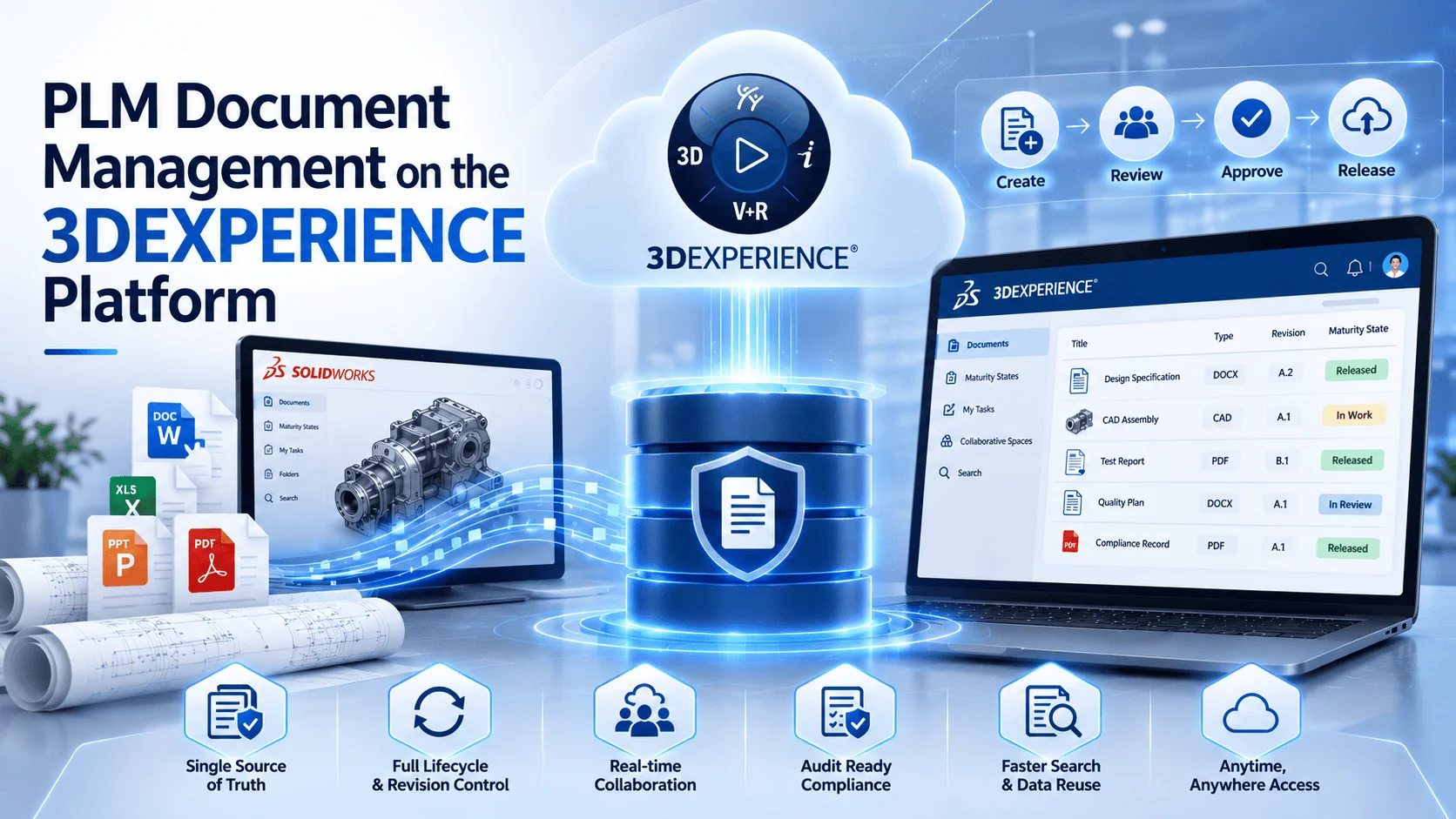
PLM document management is a cloud-native, data-driven approach to creating, controlling, and collaborating on product-related documents. Unlike traditional file-sharing systems, the platform treats every document as an intelligent object — complete with unique identifiers, revision histories, maturity states, ownership metadata, and cross-references to other product data.
This means a design specification isn’t just a Word file. It is a living entity connected to CAD models, simulation results, change orders, and compliance records. When a design engineer updates a specification, the platform can automatically notify affected stakeholders, trigger review workflows, and update compliance documentation in real time — a level of integration that siloed systems simply cannot match. This is precisely what sets PLM document management apart from a shared drive or a basic version-control folder.
Core Features of PLM Document Management
Intelligent Document Objects
Every document carries rich metadata including unique IDs, revision numbers, maturity states (In Work, Released, Obsolete), and defined ownership. This ensures complete traceability and makes audit preparation significantly easier — a foundational strength of PLM document management.
Native Microsoft Office Integration
Users can preview Office documents directly within the browser without downloading files. Editing capabilities are built in, similar to Microsoft Online editors, with automatic updates ensuring previews always reflect the latest content.
Lifecycle and Revision Control
Documents can be revised, duplicated, shared, moved, downloaded, or retired. The platform supports multi-file documents — allowing several related files to exist under a single document entry — and enables linking between documents for seamless cross-referencing. Strong lifecycle control is one of the clearest reasons teams adopt PLM document management over ad-hoc file storage.
Bookmark Editor for Organization
The Bookmark Editor functions as an intelligent folder system. Users can drag and drop documents into structured collections, then preview, edit, download, update maturity states, and create new revisions — all from a single interface.
Quality Document Author (Regulated Industries)
For organizations operating under strict regulatory frameworks, the Quality Document Author application provides enterprise-wide document control. It manages the full lifecycle of controlled quality documents — from authoring and reviewing to releasing and publishing.
Template-Based Standardization
Organizations can create standardized document templates that enforce company-wide formatting and content standards. These templates initiate electronic workflows with automated task assignments, alerts, escalations, and review cycles — another layer of PLM document management built for consistency at scale.
Automated Training and Compliance Tracking
When controlled documents are revised, the system automatically schedules training for affected personnel. Managers can monitor completion through color-coded dashboards, and users must provide electronic signatures upon completion — a critical requirement for regulatory audits.
Watermark and Distribution Control
The platform generates PDF outputs with configurable watermarks, headers, footers, and lifecycle information. It also supports controlled printing with unique serial numbers and the ability to recall printed hardcopies, ensuring users always know whether they are working with a controlled or uncontrolled version.
Advanced Search and Reuse
Full-text search capabilities allow users to locate and reuse documents and design components quickly. The platform supports filtered search, 3D part search, and metadata-driven queries that cut through large data repositories — making PLM document management a genuine productivity tool, not just a compliance requirement.
Cloud-Native Accessibility
Because the platform is delivered through the cloud, users can access, preview, and manage documents from any web-enabled device without installing client software. This supports global teams working across time zones and geographies.
How Document Management Performs on the Platform
Ecosystem Integration: Where PLM document management truly excels is within the Dassault Systèmes ecosystem. For teams using SOLIDWORKS and SIMULIA, it provides a unified data layer that connects design, simulation, and manufacturing processes without manual handoffs. Engineering BOMs, CAD files, and documents remain synchronized, eliminating the version-mismatch headaches that plague file-based workflows.
Collaboration at Scale: The platform enables real-time collaboration across disciplines and geographies. Social collaboration features, shared digital mockups, and web-based dashboards allow teams to work concurrently rather than sequentially.
Pros of PLM Document Management on 3DEXPERIENCE
| Advantage | Description |
| Deep DS Ecosystem Integration | Seamless connectivity with SOLIDWORKS and SIMULIA creates a unified workflow without complex middleware. |
| Cloud-Native Delivery | Available via SaaS, PaaS, and IaaS models managed by Dassault Systèmes, reducing internal IT infrastructure burdens. |
| Rich Metadata and Traceability | Every document carries unique IDs, revisions, maturity states, and ownership for complete audit readiness. |
| Real-Time Global Collaboration | Web-based access with social features enables seamless teamwork across continents. |
| Microsoft Office Integration | Direct preview and editing of Office documents streamlines everyday workflows. |
| Automated Training and Reviews | Auto-assignment, tracking, and periodic review scheduling ensure ongoing compliance. |
| Single Source of Truth | Centralized data prevents silos and ensures all teams work from identical information. |
Industry Verticals: Suitability Ranking (Highest to Lowest)
Not every industry extracts equal value from PLM document management. The platform’s strengths — regulatory compliance, complex product structures, multi-site collaboration, and deep CAD integration — align more naturally with some sectors than others. The ranking below is based on industry characteristics, regulatory demands, and product complexity.
#1 Life Sciences & Healthcare (Highest Value)
- Most stringent documentation requirements: FDA, ISO 13485 demand bulletproof audit trails.
- Documented improvements: 20–40% lower SOP management costs, 30% faster document review cycles.
- Key Use Cases: SOP control, regulatory submissions, CAPA management, batch records, clinical documentation, medical device design history files.
#2 Aerospace & Defense
- Massive product structures, decade-long lifecycles, and rigorous certification processes.
- Traceability, configuration management, and multi-site collaboration capabilities are critical.
- Handles requirements traceability, design certification packages, and supplier documentation across global supply chains.
- Key Use Cases: Certification documentation, requirements management, supplier quality records, engineering change packages, long-term archive and retrieval.
#3 Automotive & Transportation
- Complex systems integrating mechanical, electrical, and software components across global supply chains.
- Handles massive BOMs, supplier integration, and concurrent engineering.
- Real-time collaboration and virtual twin capabilities enable faster iteration while maintaining quality.
- Key Use Cases: Vehicle specification management, supplier documentation, homologation records, design release packages, manufacturing process documentation.
#4 Industrial Equipment & Heavy Machinery
- Configured-to-order products, long lifecycles, and global after-sales service networks.
- Growing demand for 3DEXPERIENCE portfolio management capabilities in the industrial equipment sector.
- Supports everything from initial quotations and technical proposals to as-built documentation and service manuals.
- Template-based standardization helps enforce consistency across geographically dispersed engineering teams.
- Key Use Cases: Technical proposals, as-built documentation, service manuals, spare parts catalogs, project documentation.
#5 High-Tech Electronics
- High velocity with compressed design cycles and frequent product iterations.
- Benefits from collaboration features and BOM management, but documentation needs are generally less regulated.
- Fast-paced nature means lengthy implementation cycles can be a disadvantage.
- Best fit for complex systems such as semiconductor manufacturing equipment or telecommunications infrastructure.
- Key Use Cases: Design specifications, test documentation, compliance certifications (FCC, CE), firmware release notes, manufacturing work instructions.
#6 Consumer Goods & Retail
- Prioritizes speed-to-market, packaging design, and brand consistency over complex engineering documentation.
- Collaborative features and digital mockups can benefit packaging designers and marketing teams.
- Key Use Cases: Packaging specifications, brand asset management, product briefs, supplier compliance documents.
#7 Construction & Infrastructure
- Construction involves massive document volumes, but workflows differ significantly from product-centric PLM.
- Traditional construction document management systems may be more immediately applicable.
- Key Use Cases: Building information models (BIM), project documentation, contract management, as-built drawings.
Final Thoughts
PLM document management is not a one-size-fits-all solution — it is a powerful, enterprise-grade capability that delivers maximum value to organizations with complex products, strict compliance needs, and global footprints. Life sciences, aerospace, and automotive organizations stand to gain the most, while sectors like consumer goods and construction may find only portions of the platform immediately relevant.
Success with PLM document management requires more than software licensing. It demands executive commitment, experienced implementation partners, comprehensive training, and a willingness to rethink how product information flows through your organization. For those who make that investment, the platform transforms document management from a passive administrative function into an active enabler of innovation, quality, and compliance.
Decision Framework: Why Is PLM Document Management on 3DEXPERIENCE Right for You?
“Contact IDSPL today for a personalized 3DEXPERIENCE document management assessment and roadmap.”
IDSPL — Your Trusted Dassault Systèmes Partner for 3DEXPERIENCE Excellence
| Reason | What It Means |
| Certified Dassault Systèmes Partner | Authorized partner with deep 3DEXPERIENCE expertise |
| Industry-Specific Experience | Proven deployments across Life Sciences, Aerospace, Automotive, and Industrial Equipment |
| End-to-End Services | Assessment → Roadmap → Deployment → Migration → Training → post-go-live support |
| Customization Without Complexity | Architected solutions that balance flexibility with long-term maintainability |
| Training & Change Management | Tailored programs to overcome the steepest challenge: user adoption |
| Local Support with Global Standards | Proximity, responsiveness, and regional business context |
| Proven ROI | 20–40% SOP cost reduction, 30% faster review cycles, improved audit readiness |
Ready to bring PLM document management to your organization? Contact IDSPL for a personalized assessment and roadmap.
By Shivank Srivastava | Ideas Design Solutions Pvt. Ltd. (IDSPL)