

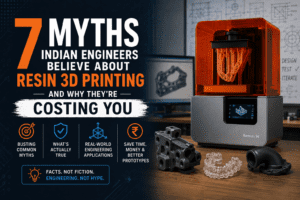
Let’s be honest.
Resin 3D printing India has a reputation problem — and most of it is not deserved. Over the years, our engineers at IDSPL have heard the same objections repeated across industries: auto-components in Manesar, textile machinery in Ludhiana, product startups in Gurugram, dental labs in Delhi. The same hesitations. The same half-truths passed around like facts at trade shows.
Some of these myths come from a bad experience with a ₹5,000 hobby printer from an online marketplace. Some come from misinformation. And some are simply outdated — true once, irrelevant today.
Here are 7 of the most persistent ones — and what is actually true.
Myth 1: “Resin 3D printing is just for models and showpieces”
The myth: Resin parts look nice but have no real mechanical strength. You can’t use them for anything functional.
The truth: This myth was born from early consumer resin printers using brittle standard resins. It hasn’t been true for years.
Today, engineering-grade resins like Formlabs’ Tough 2000 and Engineering Resin produce parts with ABS-like impact resistance and stiffness. Flexible 80A Resin mimics Shore 80A rubber. High Temp Resin withstands heat deflection temperatures up to 238°C — which is more than most thermoplastics used in injection moulding.
At IDSPL, we have customers using Formlabs resin parts as functional jigs on actual production lines, as snap-fit enclosure prototypes that get tested under load, and as tooling inserts. These are not showpieces.
What changed: Professional resin ecosystems like Formlabs are closed systems — the printer, resin chemistry, and curing process are engineered together. The result is validated, repeatable, functional parts. Not the same as buying a random resin off Amazon and hoping it works.
Myth 2: “Cheap resin printers from online marketplaces do the same thing”
The myth: A ₹15,000 MSLA printer from an online platform prints with resin, just like a Formlabs. Why pay 10x more?
The truth: The hardware is the easy part. The resin is everything — and cheap printers use whatever resin you pour in.
Professional resin printing like Formlabs is a closed, validated system. Every resin in the Formlabs library has been chemically engineered for that specific printer, tested for print settings, dimensional accuracy, mechanical performance, and — for medical resins — regulatory compliance. When you print with Formlabs Tough 2000, you get Formlabs Tough 2000 every time.
A budget printer with third-party resins gives you inconsistency. Different batches behave differently. Layer adhesion varies. Mechanical properties are guesswork. For a hobbyist printing miniatures, that’s fine. For an engineer validating a product design, it is a liability.
The real cost of a cheap printer is not the purchase price — it is the failed prints, the reprints, the wasted resin, the missed delivery deadline, and the client who received a part that failed in testing. We have seen it happen.
Myth 3: “Resin printing is toxic and dangerous — not suitable for an office”
The myth: Resins are hazardous chemicals. You need a special room, ventilation systems, and protective equipment. It is not practical for a normal engineering office.
The truth: Modern professional resin printers are designed specifically for office environments.
The Formlabs Form 4 and Form 4L are enclosed machines. The resin cartridges are sealed systems — you do not open vats of liquid resin. The post-processing wash station (Form Wash) is also enclosed. With basic precautions — nitrile gloves during post-processing, avoiding skin contact with uncured resin — the workflow is perfectly safe in a standard office or lab.
Formlabs explicitly markets the Form 4 as an office-friendly 3D printer and it is used in hospitals, dental clinics, engineering colleges, and corporate design studios worldwide. IIT labs in India run these machines.
Respect the material? Yes. Fear it to the point of not adopting the technology? Absolutely not.
Myth 4: “3D printing replaces skilled engineers and machinists”
The myth: If you buy a 3D printer, you don’t need your design engineers or machinists anymore.
The truth: 3D printing is a tool, not a replacement for engineering judgment.
A Formlabs printer does not design the part — your engineer does. It does not decide which material to use — your application demands it. It does not determine tolerances, wall thickness, or support strategy — that still requires someone who understands manufacturing principles.
What 3D printing does is collapse the time between idea and physical object. A design iteration that once took two weeks through a vendor now takes overnight. That speed means your engineers can test more ideas, fail faster and cheaper, and arrive at a better final design.
In practice, companies that adopt professional 3D printing don’t reduce their engineering headcount — they make their engineers significantly more productive.
Myth 5: “SLS and resin printing are the same thing”
The myth: All professional 3D printing is roughly the same. Whether it’s SLA, SLS, or FDM — it all just builds up layers of material.
The truth: SLA/MSLA resin printing and SLS are fundamentally different technologies producing fundamentally different parts — and choosing the wrong one for your application is expensive.
Resin printing (SLA/MSLA): Uses UV light to cure liquid resin. Produces parts with outstanding surface finish, fine detail, and good dimensional accuracy. Requires support structures. Best for visual prototypes, dental/medical, jewellery, and functional parts where surface quality matters.
SLS (Selective Laser Sintering): Uses a laser to fuse powdered nylon. No support structures needed — parts are self-supporting in the powder bed. Produces parts with excellent mechanical properties that can function as true end-use components. Best for complex geometries, snap-fits, hinges, enclosures, and small-batch production runs.
Choosing resin when you need SLS durability means brittle parts. Choosing SLS when you need resin surface finish means rough, grainy surfaces. At IDSPL, we help customers identify which technology fits their specific application — because the wrong choice wastes money regardless of the printer quality.
Myth 6: “3D printing is only for big companies and MNCs”
The myth: Only large manufacturers with big R&D budgets can justify a professional 3D printer. For smaller companies, it doesn’t make financial sense.
The truth: The economics have inverted completely — and SMEs often benefit more than large companies.
Here’s a simple calculation many of our customers in Ludhiana and Gurugram have run:
A custom plastic bracket that requires an injection mould costs between ₹80,000 and ₹3,00,000 in tooling — before you produce a single part. If the design changes (and it almost always does), you pay again.
The same bracket on a Formlabs Fuse 1+ SLS printer costs a few hundred rupees in nylon powder and prints overnight. Redesign it tomorrow if you need to. No tooling. No minimum order quantity. No lead time.
For a small manufacturer producing 10–200 units of a custom component, 3D printing is not just competitive with injection moulding — it is dramatically cheaper, faster, and more flexible. The break-even point against injection moulding tooling is usually under 500 units for most parts.
Myth 7: “Once you buy the printer, you’re on your own”
The myth: 3D printer vendors sell you the hardware and disappear. When something goes wrong — a failed print, a resin compatibility question, a mechanical issue — you are left searching YouTube.
The truth: This is unfortunately true of many budget printer brands sold through online marketplaces. It is not true when you buy through an authorised reseller like IDSPL.
When you buy a Formlabs printer through IDSPL, you get:
- Installation and onboarding at your facility by our certified team
- Hands-on training for your engineers and operators
- Local resin and powder supply — no waiting for international shipping
- On-site and remote technical support from engineers who understand both the hardware and the engineering applications
- The backing of 27 years of engineering software and hardware expertise in North India
We have supported SOLIDWORKS and engineering hardware customers since 1997. We are not going anywhere, and neither is your support contract.
So, What Should You Actually Do?
If any of these myths made you hesitate to explore resin or SLS printing for your work, we would encourage you to ask for a demonstration before deciding anything.
Come to our Gurugram office and see a Formlabs Form 4 or Form 4L print something. Hold an SLS nylon part in your hand. Show us your application — a bracket, a housing, a prototype — and we will tell you honestly whether 3D printing is the right answer, which technology fits, and what the economics look like.
No obligation. No pressure. Just engineering.